
Resilience
It's not just bouncing back.


Photo by Brett Jordan on Unsplash
Resilience
There’s no shortage of books and content promising to teach you how to “bounce back” from failure and handle stress without breaking. It’s a growth industry — which tells you something about how much we’re struggling.
But bouncing back is a low bar. Real resilience is something more demanding and more rewarding: the combination of self-regulating in the face of stress and learning from failure. These aren’t soft skills. They are disciplines — ones that can be developed, practiced, and made permanent.
Self-Regulation
Resilience begins with what happens in your body before your brain has a chance to catch up.
As Dan Goleman famously described it, the brain’s response to threat is triggered by the amygdala — that ancient, primitive part of the brain that gears us up for fight, flight, freeze, or fawn (appeasement) before the thinking brain has any say in the matter. Until those automatic responses are regulated and higher brain functions have an opportunity to engage, we are at the mercy of our wiring, not our wisdom.
Viktor Frankl pointed to what becomes possible on the other side of that regulation:
“Between stimulus and response there is a space. In that space is our power to choose our response. In our response lies our growth and our freedom.”
That space is what self-regulation creates.
Emotional self-regulation is the ability to monitor and manage your energy states, emotions, thoughts, and behaviors — to control impulses, adapt to changing circumstances, and reduce stress — in ways that serve your goals and well-being rather than just discharging your survival wiring. Key practices include mindfulness, deep breathing, and cognitive reappraisal.
Signs of Poor Emotional Self-Regulation
• Outbursts disproportionate to the situation
• High levels of stress, anxiety, and frustration
• Difficulty calming down after being upset
• Impulsive behavior and difficulty focusing
The Stages of Self-Regulation
Self-regulation isn’t a single act. It unfolds through four interconnected moves:
• Monitoring: Noticing what’s happening — in your environment and inside yourself
• Understanding: Recognizing and naming your feelings and reactions
• Comparing: Measuring your current behavior against what you’re actually committed to
• Adjusting: Actively changing your thoughts, feelings, or actions to bring them into alignment with your goals
In a previous article, I laid out what I call the transformational approach:
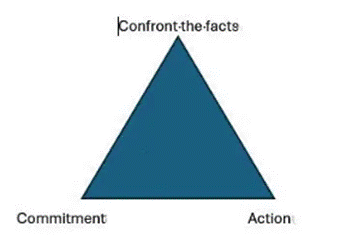
These two frameworks map closely onto each other. Monitoring and understanding are about confronting the facts — internal and external — of the situation. Comparing is the moment of measuring current behavior against your commitment. And adjusting is the action called for by that honest reckoning.
Types of Self-Regulation
Self-regulation operates across several dimensions:
• Biological: Managing physical arousal, energy levels, and sensory input
• Emotional: Managing feelings to respond appropriately rather than reactively
• Cognitive: Managing mental processes — focus, planning, problem-solving
• Behavioral: Controlling impulses and acting in ways that serve your actual intentions
• Social: Reading social cues and interacting in ways that strengthen rather than damage relationships
Practices That Build Self-Regulation
• Mindfulness: Practicing awareness of the present moment, body sensations, and thoughts
• Deep Breathing: Using slow, deliberate breaths to reduce heart rate and interrupt the stress response
• Cognitive Reappraisal: Changing how you interpret a situation to reduce its emotional grip
• Self-Reflection: Regularly examining your emotional and behavioral responses — honestly, not defensively
• Structure and Routines: Creating consistency and reducing environmental triggers for reactivity
• Setting Goals: Defining what you’re committed to, so you have something to self-regulate toward
Learning
Self-regulation is at the heart of short-term resilience — managing yourself through difficulty in the moment. Learning is what makes resilience durable. It transforms a series of hard events into a practice.
The ROI of Failure
Both success and failure involve investment of resources — time, money, and talent. As with any investment, what matters is the return. The ROI of success is obvious: you achieved what you set out to achieve. The ROI of failure is learning. If I invest the equivalent of $50,000 in time, money, and talent toward an intended outcome and fail to achieve it, it is incumbent on me to extract $50,000 worth of learning from that investment. Anything less is a write-off. That’s not resilience — that’s waste.
Let me be personal about this.
Several years ago, I was employed by a boutique consulting firm, delivering programs and coaching all over the world. At the end of my first year, I received an award as MVP of the year. In June of the following year, I was fired — due to performance issues that had led to serious client complaints.
That was, unambiguously, a significant failure.
And like most humans, my first response was anything but regulated. I blamed the client. I blamed the company. I blamed the circumstances. And then, privately, I blamed myself — certain that there must be something fundamentally wrong with me, especially since this was not the first time this pattern had shown up in one form or another.
What saved me was my community. I am surrounded by coaches and consultants who are committed to my greatness even when I’ve lost sight of it, and committed to a transformational approach to difficulty. They refused to let me settle for a convenient story. They insisted I look deeper — for learning that would actually be commensurate with the failure.
The transformational approach begins with confronting the facts. And the fact — the one I hated to admit — was that this was a pattern. When I looked honestly across my professional life, I had repeatedly snatched defeat from the jaws of victory.
When I examined that pattern fully, and in the light of a lifetime of work on myself, I recognized what it was rooted in: a lifelong need to prove myself, stemming from growing up in the shadow of an older brother I felt I couldn’t measure up to. (If you’re interested in the full story, read my book Transformation: From Potential to Practice and follow the character “Jimmy” through the first half — those who know me well have noticed a close resemblance.)
Once I confronted the facts of the pattern — including what it had cost me — the next question was: What am I committed to? The answer was clear: to allowing myself to be successful without then sabotaging that success. And from there, the third question: In the light of that commitment and those facts, what action is called for?
That, too, became clear. I needed to learn to recognize the early warning signs of the pattern — trying too hard, blaming the people around me, feeling underappreciated and unseen — and re-align my actions with my commitment rather than my survival strategy. And I needed to enlist my community to help me stay accountable, watching for the signs even when I couldn’t see them myself.
The recovery from that failure has proven invaluable. The pattern has not taken over since. My work has been consistently successful. The ROI matched the investment.
That’s what resilience actually looks like. Not bouncing back to where you were. Moving forward, wiser, with yourself more fully in hand.
Interested in more of this kind of thinking? Check out the Practitioners Studio at https://ilumn8.life/op/the-practitioners-studio/
Edward M. Gurowitz, Ph.D. is a psychologist, executive coach, and organizational consultant with 50+ years of experience in personal and organizational transformation. He is the author of Transformation: From Potential to Practice (2025) and Inclusion, the Role of Leadership (2019), and the principal of Integrated Business Solutions, LLC.
As usual, Dr. Gurowitz gets the heart of the matter, providing a thoughtful, concrete framework for understanding the nature of human resilience and what it takes to build and sustain it in the face of human imperfection and real-life challenges.
Interested in more of this kind of thinking? Check out the Practitioners Studio at https://ilumn8.life/op/the-practitioners-studio/