
Facts, Commitment, Action
The Only Transformation Framework You Need

In the model of transformation I present in my book Transformation: From Potential to Practice, I posit that transforming any experience begins with confronting the reality of what happened, then creating or reasserting what one is committed to, and then basing one’s actions on that reality and commitment rather than on a default survival strategy:
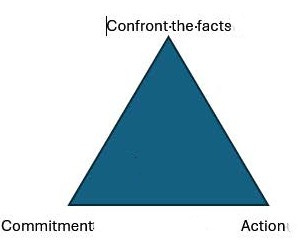
This triangle represents a key practice of transformation and an antidote to the blame-based Drama Triangle (sometimes called the Victim Triangle).
CONFRONT THE FACTS
To understand this first step, we must first sort out what are facts. This is especially important in the current socio-political environment, where too often people assert what they claim to be facts, which are not facts at all. Anything asserted as a fact must meet three criteria:
It must be real, not imaginary and not a concept or abstraction – that which is held to be a fact must have physical reality of some kind (and for these purposes, most AI generated material including pictures, are not real.)
It must be evident. That is, there is evidence of its existence. Simply put, if it cannot be captured by some sort of register, e.g., a recording, it is not real. An earthquake can be registered on a seismometer, so it is a fact. Unicorns cannot be registered, so they are not facts.
It must be demonstrable. There are no “private” facts – anything that is factual can be shown to another person in some way – they see it, hear it, feel it (kinesthetically, not emotionally), smell it, etc.
We say that anything that meets these three criteria is a fact, or put another way, it is true. Anything that does not is not real or false.
Much of our inner experience doesn’t meet the criteria for facts — and that’s fine. Fear, grief, beauty, intuition: these are real, but they’re not facts. They’re the meaning we make of facts. We call that meaning interpretation. (Actually, this category has many names: interpretations, conclusions, judgments, analyses, assumptions. For our purposes here, we’ll use the single word interpretations to cover all of them.)
Interpretations are always about facts, not substitutes for them. A thunderstorm is a fact. To a city dweller, it’s an inconvenience. To a farmer waiting to plant, it’s a disaster. Same fact — entirely different interpretations — and both can be valid.
Just as we judge facticity by the three criteria for truth, interpretations must pass their own test, namely they must be valid. Validity is measured by how well the interpretation fits the facts. The city dweller in the example might find “inconvenience” a valid interpretation, but the farmer might feel it was a massive understatement, preferring instead to call it a disaster. If I say someone is a fool or an idiot, the validity of that interpretation might be open to discussion. If I say a certain gray animal is an ass, that may be a fact, but if I say it about a person no one will think I mean he has long ears and a tail.
COMMITMENT
Once I have sorted out what in my situation are facts and what are interpretations, my job is not to invalidate the interpretations, but to accept them as such, to feel my feelings, etc., and be clear on what the facts are, then move on to the question “what is my commitment in this situation?”
A poignant example of this is recounted in the recent book This Sweet Life: How We Lived after Kirby Died by Virginia and Jean Brown. Briefly, the book recounts the tragic loss of the Browns’ daughter and sister when she died along with two others in a badly managed sweat lodge run by James Arthur Ray, a cult leader who was convicted of negligent homicide in the case.
The Browns recount how they dealt with grief, anger, sorrow, etc., while at the same time working to sort out what happened including Ray’s actions in the aftermath of the deaths. They did not bypass the pain, but they didn’t to stop there. They went on to create a commitment to guiding safer self-discovery within the self-help industry and to work to protect consumers from harm.
Commitment is not arbitrary, and it doesn’t appear from nowhere. It grows from who you already are and what you already care about.
Both Virginia and Jean had deep prior commitments to helping people. Virginia is a Licensed Clinical Social Worker; Jean holds a master’s degree in public policy and administration.
ACTION
Many people say they are committed to many noble things – ending hunger, ending war, anti-racism or raising healthy, happy kids, and these are all noble commitments, but unless these commitments form a platform for their lives and for committed action, they are not transformative.
Out of their commitment, the Browns created SEEK Safely, an organization that is dedicated to promoting safety, ethics, and accountability in the self-help and wellness industries. The organization works across four areas: Education and Advocacy, the Seek Safely Podcast, Tools and Workshops, and Legal and Legislative efforts.
None of what the Browns have built is a quick fix or a single gesture. It has been — and continues to be — a sustained practice, rooted in commitment. That is what makes it transformative.
SIDENOTE ABOUT TRANSFORMATION:
First: Transformation is always available. It is never too late and no situation is too far gone. The potential is always present.
Second: Transformation is a practice, not an event. It doesn’t happen once and stay. It requires repeated, intentional action. As I call it in my book, Practice, over time, in community.
HERE IS THE TRANSFORMATION TRIANGLE PRACTICE IN SUMMARY:
Sort out the facts from interpretations. Honor what you feel and focus on the facts to answer the question “what now?”
Ask yourself, “what am I committed to?” This is a question about the present and the impact of the facts, and its focus is on the future. Not what you wish was different — what you are genuinely committed to, given the facts as they are.
Act from that commitment. Identify what actions – short, medium, and long-term – are called for, and take them. This requires courage and putting one’s commitment ahead of one’s fear.
Until one is committed there is always hesitancy, the chance to draw back, always ineffectiveness.
Concerning all acts of initiative and creation there is one elementary truth, the ignorance of which kills countless ideas and splendid plans.The moment one commits oneself, then Providence moves too. Multitudes of things occur to help that which otherwise could never be.
W.H. Murray, The Second Scottish Himalayan Expedition
Murray closes with a line often attributed to Goethe — one worth sitting with:
Whatever you can do or dream you can, begin it. Boldness has genius, power and magic in it.
Transformation begins not when everything is certain, but when you commit anyway.
Join Us
SEEK Safely Summit: Building Solutions
If this conversation sparked something in you, I’d love to see you there. The Summit brings together voices committed to safety, accountability, and real change in the world of personal development. Tickets are on sale now.
Ed Gurowitz is the author of
Transformation: From Potential to Practice, A Handbook for Personal and Organizational Change
and
Inclusion, The Role of Leadership: Why We Are Separate, Why We Need to Come Together
A coach and facilitator with decades of experience working with leaders, teams, and individuals, Ed helps people close the gap between who they intend to be and how they actually show up.